The Architecture Capital of the Desert
Palm Springs sits at the base of the San Jacinto Mountains at the northwest end of the Coachella Valley, a basin stretching roughly 45 miles east toward Indio and south toward the Salton Sea. Its identity is inseparable from mid-century modern architecture. Multiple hosts who manage properties here describe Palm Springs as having "the largest collection of preserved mid-century modern architecture in the world," and the scale of what survived is remarkable: postwar building at peak modernism, architects who found in the flat desert floor and mountain backdrop an ideal laboratory for open plans, floor-to-ceiling glass, and outdoor rooms designed to pull the landscape inside.
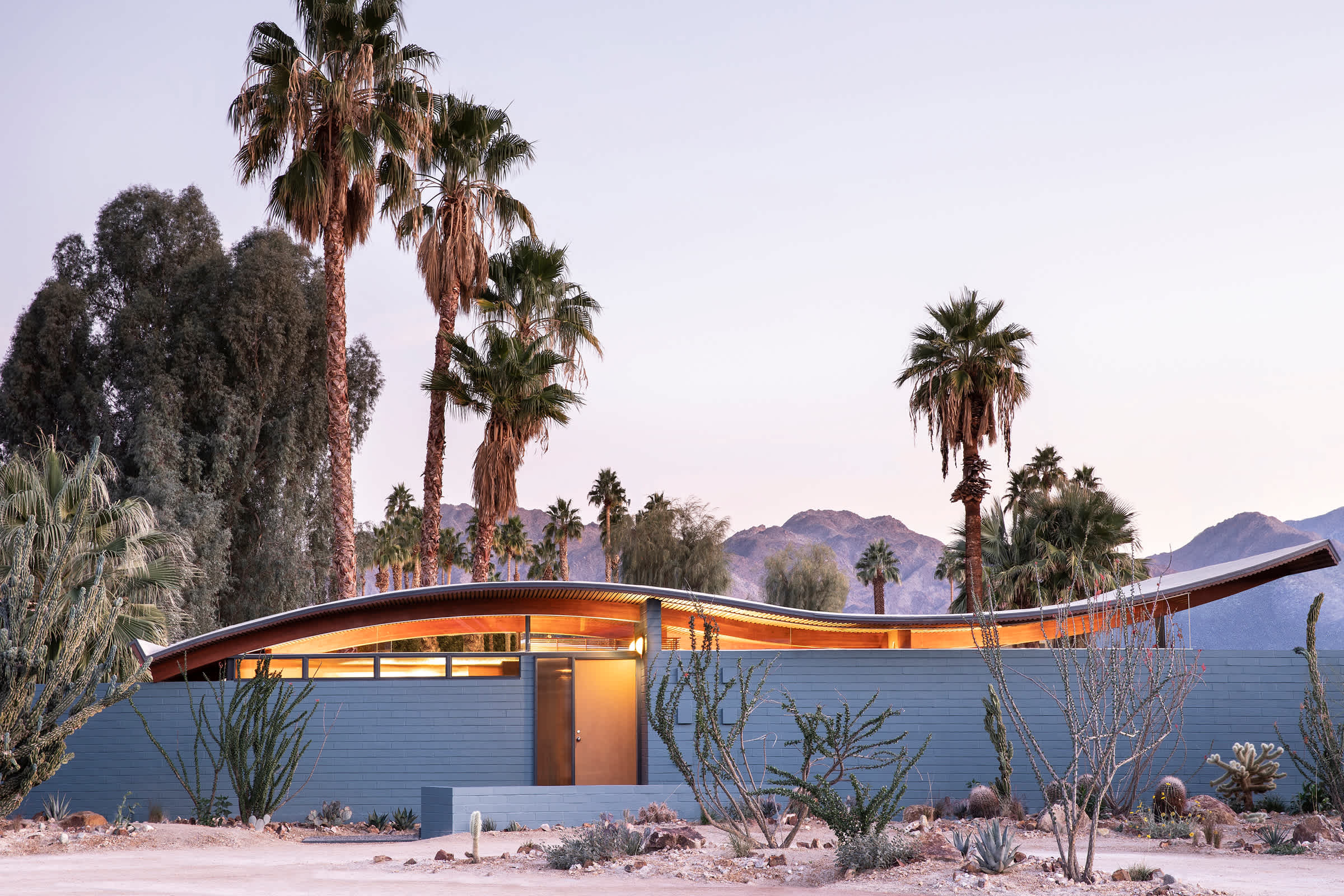
The architects who built Palm Springs into a design destination include Walter S. White, who designed the Desert Wave in Palm Desert in 1955 — a sweeping structure with a roofline that mirrors the San Jacinto ridgeline, designated a National Historic Landmark and fully restored by Stayner Architects to honor its original design intent. William Krisel is perhaps the most prolific of the Palm Springs modernists, designing hundreds of homes across the city's residential neighborhoods, each iteration refining the butterfly roofline and indoor-outdoor logic that became the area's signature style. Albert Belden Crist designed his own residence in the Movie Colony neighborhood — part of a generation of architects who treated the city itself as a working portfolio.
The city now has organized infrastructure for architectural tourism. The Palm Springs Modern Committee (Ps Mod Com) organizes events and tours throughout the year, including Modernism Week — held each February — a festival of house tours, architect talks, and open houses that draws designers and architecture enthusiasts from around the world. The Palm Springs Art Museum Architecture and Design Center in the Stevens-Edwards Pavilion runs rotating exhibitions dedicated to the built environment of the region.
William Krisel and the Butterfly Roofline
The butterfly roofline — two angled roof planes meeting at a low center ridge, forming an inverted V — became the signature element of Palm Springs modernism, and William Krisel its most persistent champion. Krisel designed thousands of homes across Palm Springs between the 1950s and 1970s, most in the tract neighborhoods that now define the city's residential character: Racquet Club Estates, Twin Palms Estates, El Rancho Vista Estates.
The achievement of Krisel's work was bringing modernist principles — clerestory windows, open plans, indoor-outdoor continuity — to middle-class budgets. A Krisel home was affordable in 1960; today they are prized as architecturally significant originals, the best-preserved on the National Register of Historic Places.
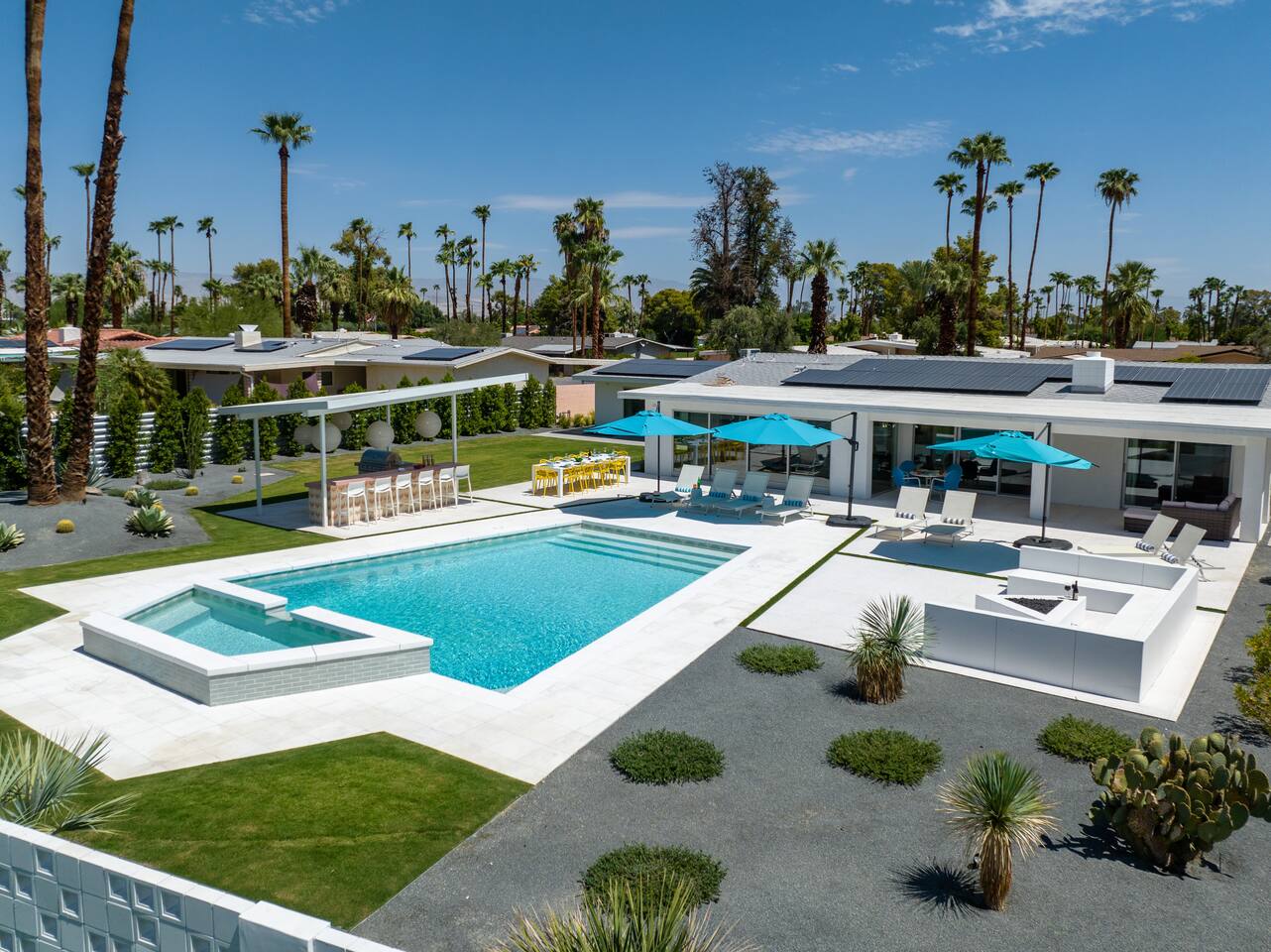
SunKissed Krisel, a 1959 home in the Racquet Club Estates, is among the most intact examples available as a vacation stay: the butterfly roofline is original, the cathedral ceilings are original, and the interior has been carefully restored with vintage-period furnishings that honor Krisel's intent. It sits on a private cul-de-sac — minutes from downtown Palm Springs and the legendary Palm Springs Aerial Tramway — with a heated pool, hot tub, and firepit, the San Jacinto Mountains framing every outdoor view.
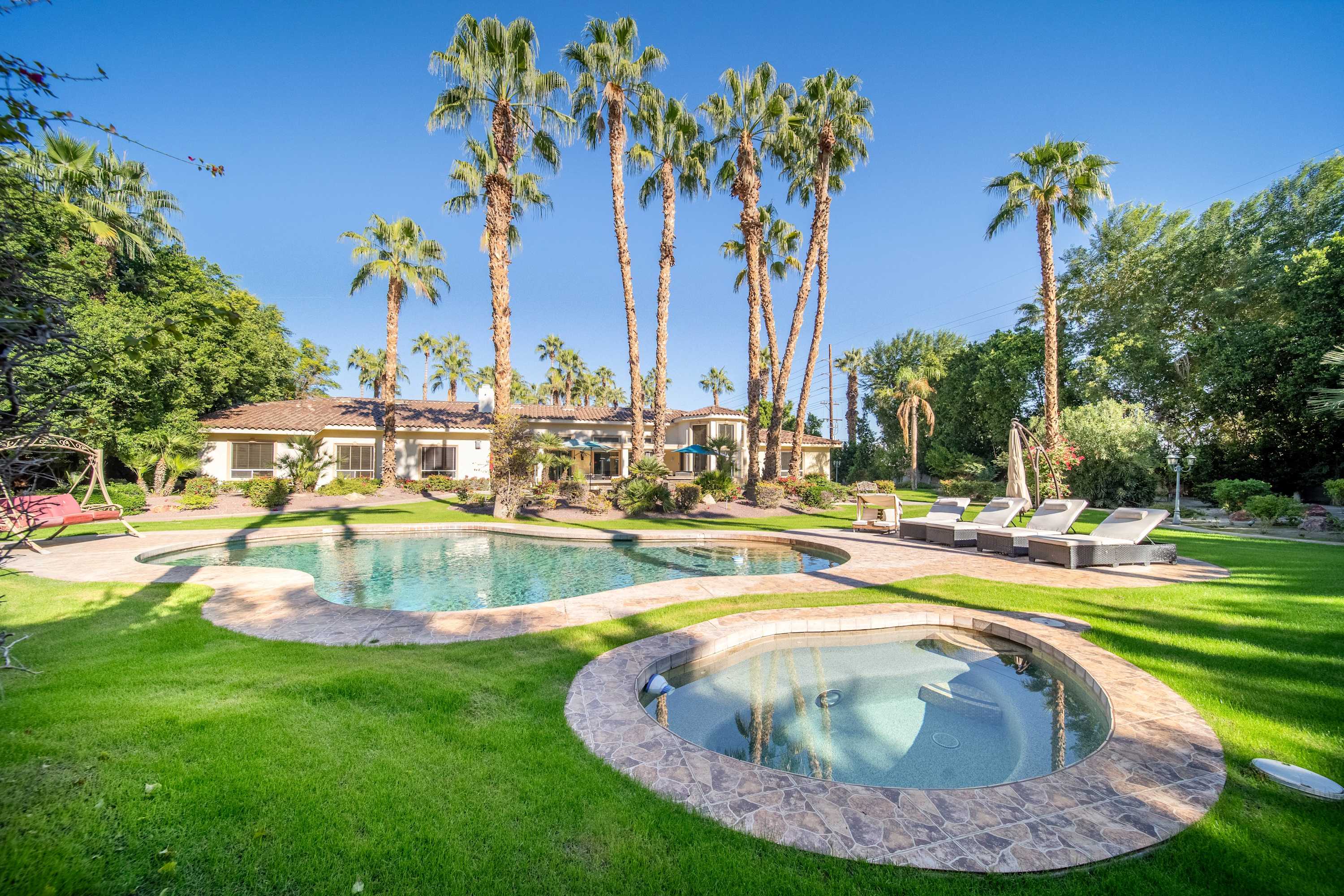
The Belden Crist House, designed by architect Albert Belden Crist as his personal residence in the historic Movie Colony neighborhood, shows what the mid-century era looked like at the higher end: five bedrooms, a pool, a hot tub, outdoor dining for eight, and spaces that open fully to the desert. The Movie Colony was where Hollywood's elite built and rented during the postwar decades — the neighborhood's architectural coherence and mature palms survive intact today.
The San Jacinto Mountains and the Aerial Tramway
The eastern face of Mount San Jacinto rises from the desert floor to 10,834 feet in just over a mile of horizontal distance — one of the most dramatic escarpments in North America. The Palm Springs Aerial Tramway ascends that face in a rotating tram car, climbing from a desert base station to a mountain station at 8,516 feet in approximately ten minutes. At the top: San Jacinto State Park, with 50 miles of hiking trails, including the summit trail to the peak — 5.5 miles and 2,300 feet of gain from the tram station. In winter, the temperature difference between the desert floor and the mountain station can exceed 40 degrees; snow lingers at the summit into May.
The mountain's presence defines Palm Springs from the outside. Its ridgeline appears in nearly every outdoor view in the valley — visible from pools, patios, and streets across Palm Springs and Palm Desert.
Listing hosts consistently describe the San Jacinto backdrop as one of the primary draws of the region, and it delivers differently through the day: pale granite at noon, amber at late afternoon, deep violet at dusk. The area around the tramway base has nature trails and preserves that allow access to the mountain foothills, and several hosts note hiking, horseback riding, and biking among the activities available to guests without a tram ticket.
The Movie Colony and Architectural Heritage
Palm Springs became a destination for Hollywood's elite during the 1930s and 1940s — actors, directors, and studio executives drawn by the desert's dry heat, the privacy of the landscape, and the manageable drive from Los Angeles. The Movie Colony neighborhood, northeast of downtown Palm Springs, was where many of them built or rented homes. The architectural legacy of that era survives: the low-slung mid-century homes, the mature palms, the private pools, and the grid of residential streets that feel genuinely apart from the commercial city around them.
The Belden Crist House sits within this neighborhood — designed by its architect-owner as a personal residence, it combines the aesthetic rigor of serious mid-century architecture with the lush outdoor living that defined Hollywood-era Palm Springs. The home's fireplace, poolside lounge, and framed mountain views feel like a direct continuation of the design philosophy that made the neighborhood what it is.
Downtown Palm Springs and the Uptown Design District — centered on North Palm Canyon Drive — concentrate vintage boutiques, interior design shops, galleries, and dining in a walkable corridor that reflects the city's design-forward culture year-round. Listing hosts consistently point to the Design District as a key nearby destination for guests, and it functions as the city's main commercial artery for cultural tourism.
The Empire Polo Club, Coachella, and Valley Culture
The Coachella Valley Music and Arts Festival — held each April at the Empire Polo Club in Indio — has become one of the defining music events in the world, and it has transformed an already culturally active region into a global destination. Accommodations across the valley fill months in advance for festival weekends. The Desert Wave in Palm Desert notes it sits "20 minutes from the Empire Polo Club" — and that proximity is a defining feature of the valley during festival season.
Stagecoach, the country music festival held at the same venue the following weekend, extends the cultural calendar. The Indian Wells Tennis Garden hosts the BNP Paribas Open — one of the largest tennis events in the world outside the Grand Slams — each March, drawing serious tennis audiences to the valley for two weeks. The Desert Wave listing notes the property sits "10 minutes from the Indian Wells Tennis Garden."
Valley Communities: Palm Desert, Rancho Mirage, La Quinta
The Coachella Valley is a connected series of cities extending east from Palm Springs. Palm Desert is home to El Paseo, the valley's main shopping and gallery corridor, and to the McCallum Theatre, the region's primary performing arts venue. Rancho Mirage has mid-century celebrity history and a quieter residential character. La Quinta anchors the southeastern end of the valley as a resort and golf destination, built around the historic La Quinta Resort and the PGA West complex.
Golf is embedded in the valley's identity: over 100 courses across the valley's cities, with PGA West hosting the Pete Dye Dunes Course, the Arnold Palmer Private Course, and the Jack Nicklaus Private Course. Many private rental homes sit directly on fairways — golf, mountain, and lake views combined in a single outdoor setting. For guests who prefer the pool to the course, the same mountain-and-open-sky backdrop frames both equally well.
Joshua Tree and the High Desert
Joshua Tree National Park sits approximately 40 miles from Palm Springs — under an hour by car. The drive passes through the agricultural and resort communities of the Coachella Valley before climbing through the San Gorgonio Pass into a stripped-down, boulder-strewn landscape that belongs to a different world entirely. The park's 795,000 acres straddle the Mojave and Colorado deserts, with distinct ecosystems on each side of the transition zone. Several listing hosts note Joshua Tree's proximity as a primary location advantage, and the Coachella Valley cities make natural bases for park day trips that return to a heated pool by evening.
The contrast between the valley and the park is part of the experience. A morning swim beneath the San Jacinto Mountains and an afternoon in the absolute silence of the Mojave represent two very different versions of the California desert — separated by less than an hour of driving.
When to Visit
October through May is the core season. Daytime temperatures range from the mid-60s to the low 90s during these months, evenings are cool, and the full cultural calendar — Modernism Week in February, the BNP Paribas Open in March, Coachella and Stagecoach in April — runs through the spring. Summer brings extreme heat: highs regularly exceed 110°F, and many businesses and cultural institutions operate on reduced schedules. The mountains become the attraction, with the Aerial Tramway providing a reliable escape to cooler air above 8,500 feet.
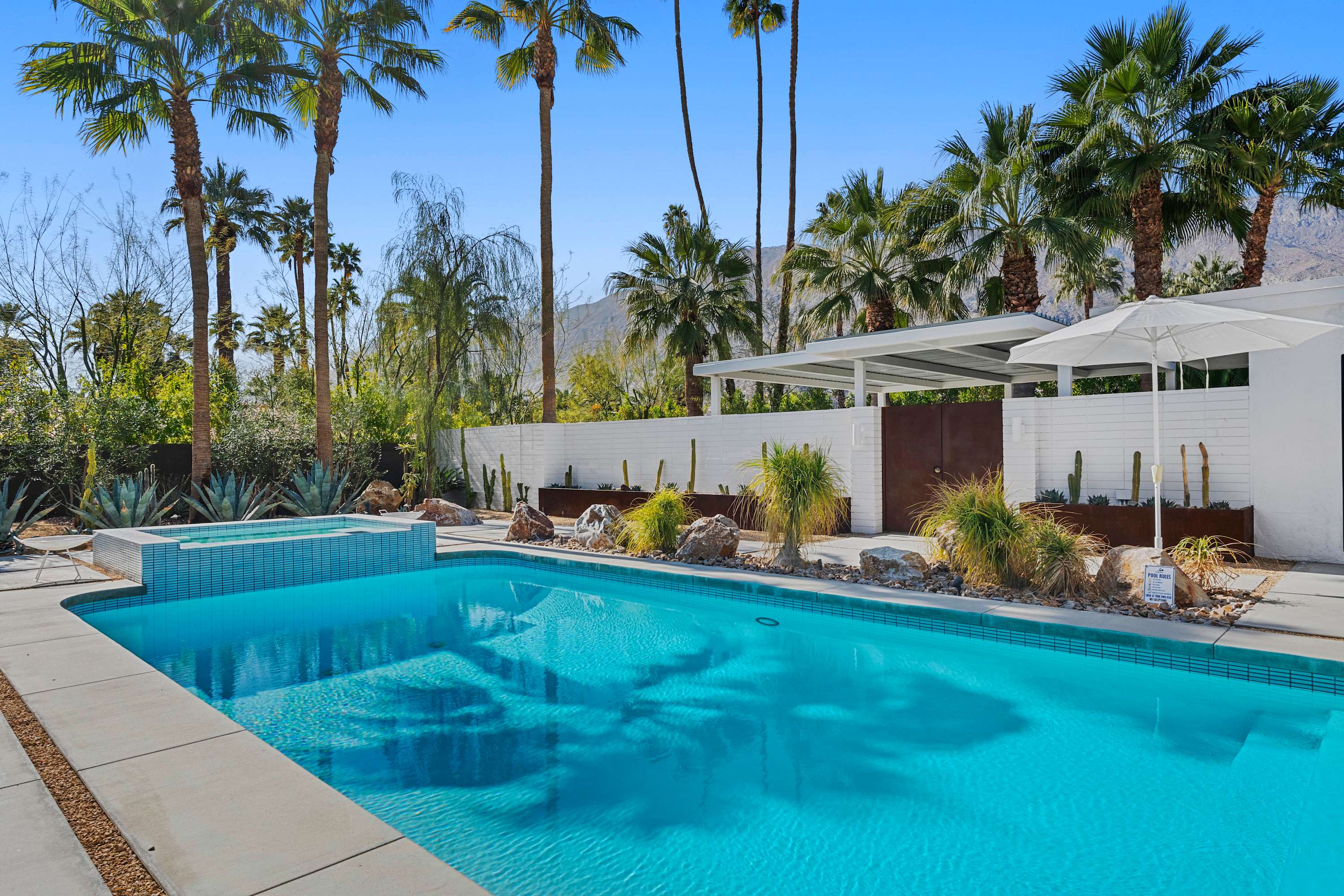
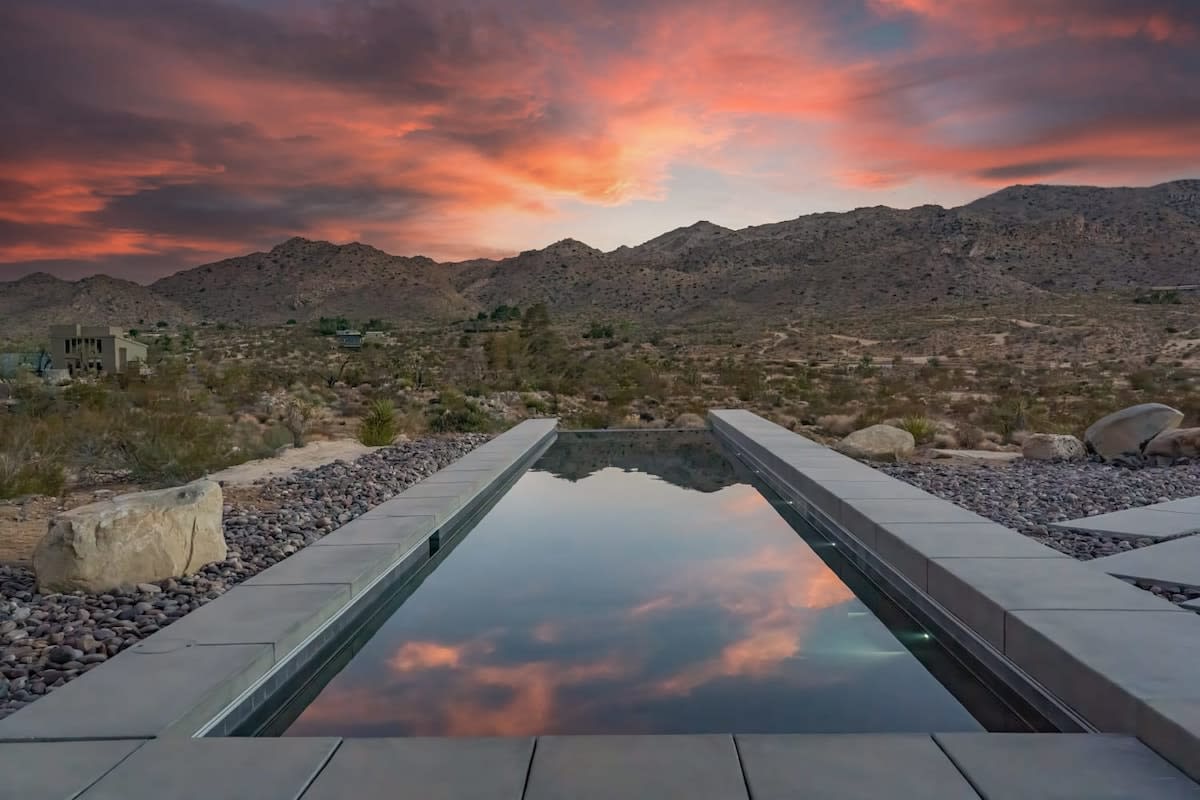
The pool season in practice runs year-round for guests who choose properties with heated pools — many listings include pool heating as a seasonal option, making January evenings by the water genuinely comfortable. Winter sunsets over the San Jacinto ridgeline, with a heated saltwater pool in the foreground and no one else for miles, are among the more specific pleasures the desert offers.
Find your base in Palm Springs, CA — browse stays indexed by CielStay.
Search stays on CielStay →Frequently asked questions
When is the best time to visit Palm Springs?
October through May is the peak season in the Coachella Valley, with daytime temperatures ranging from the mid-60s to the low 90s. Summer (June through September) brings extreme heat — highs regularly exceed 110°F — and many businesses operate on reduced schedules. The spring calendar is the most active: Modernism Week in February, the BNP Paribas Open tennis tournament in March, and the Coachella and Stagecoach music festivals in April. Accommodations across the valley fill months in advance for festival weekends.
How far is Palm Springs from Los Angeles?
Palm Springs is approximately 110 miles east of Los Angeles — about a 2-hour drive via I-10 in normal traffic, and up to 3 hours on busy Friday afternoons. Palm Springs International Airport (PSP) offers direct flights from over 20 US cities, making the valley an easy long-weekend destination without a long drive. The route east through the San Gorgonio Pass — marked by dense wind turbine fields on both sides of the highway — signals the transition from the Southern California basin into the desert.
What is the best way to experience mid-century modern architecture in Palm Springs?
The [Palm Springs Modern Committee](https://psmodcom.org/) organizes walking and driving tours throughout the year. Modernism Week — held each February — is the flagship event, with ticketed tours of private homes, architect talks, and film screenings. The [Palm Springs Art Museum Architecture and Design Center](https://www.psmuseum.org/architecture-design-center/) in the Stevens-Edwards Pavilion has rotating exhibitions on regional architecture. Many significant buildings — in neighborhoods like Racquet Club Estates, Twin Palms Estates, and the Movie Colony — are visible from public streets and accessible by bike or on foot.
Is Palm Springs a good destination for golf?
The Coachella Valley has over 100 golf courses across Palm Springs, Palm Desert, Rancho Mirage, La Quinta, and Indio — one of the densest golf corridors in the United States. PGA West in La Quinta includes the Pete Dye Dunes Course, the Arnold Palmer Private Course, and the Jack Nicklaus Private Course, and the valley hosts multiple PGA Tour events each year. Many private rental homes are positioned directly on fairways, with course, mountain, and lake views combined, and several properties include direct course access for guests.
Stays near this guide
Top-rated independent stays in the region, ranked by CielStay authenticity score.
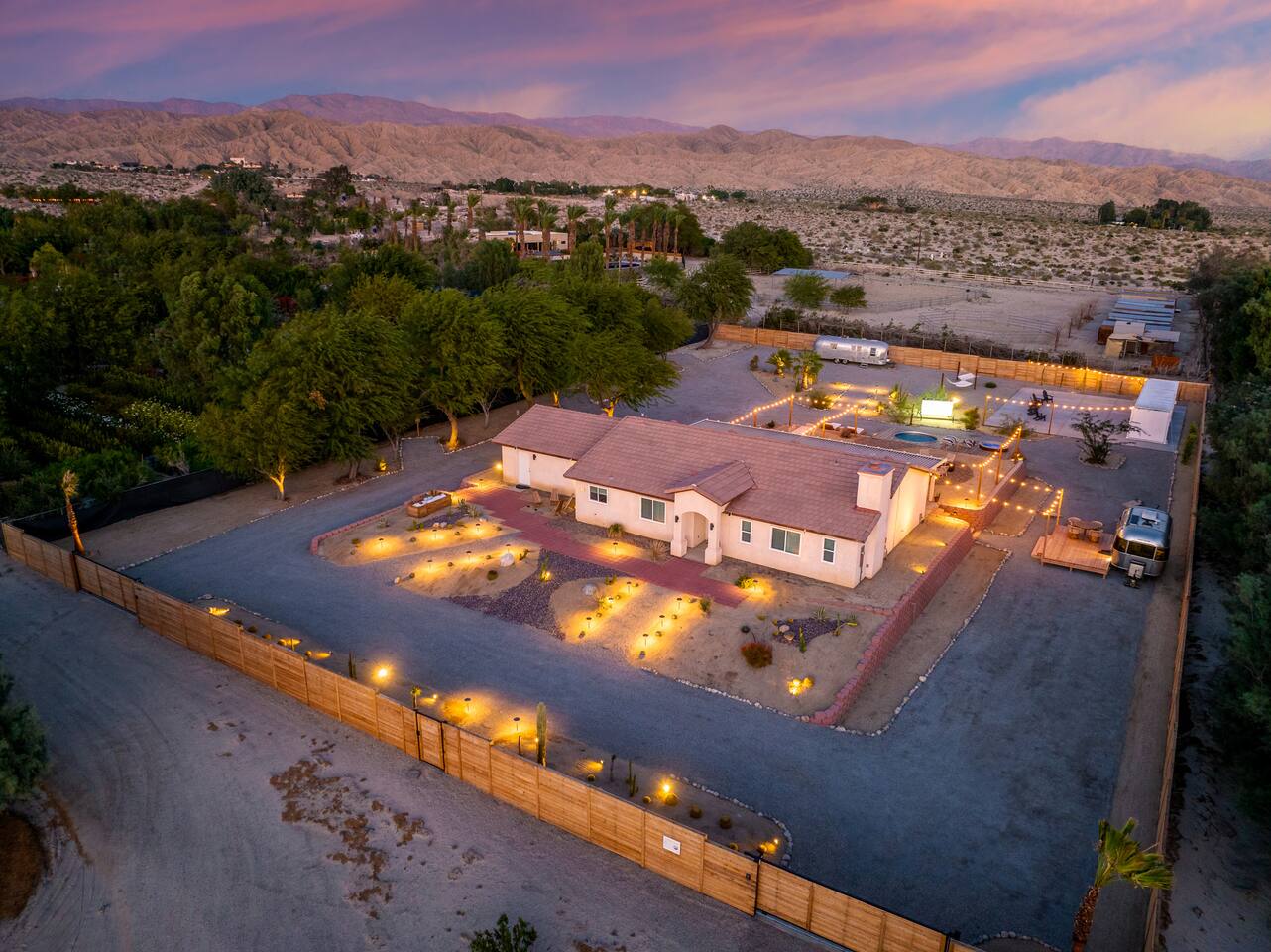
Try a search
Searches inspired by this guide — describe the vibe you want.
More guides
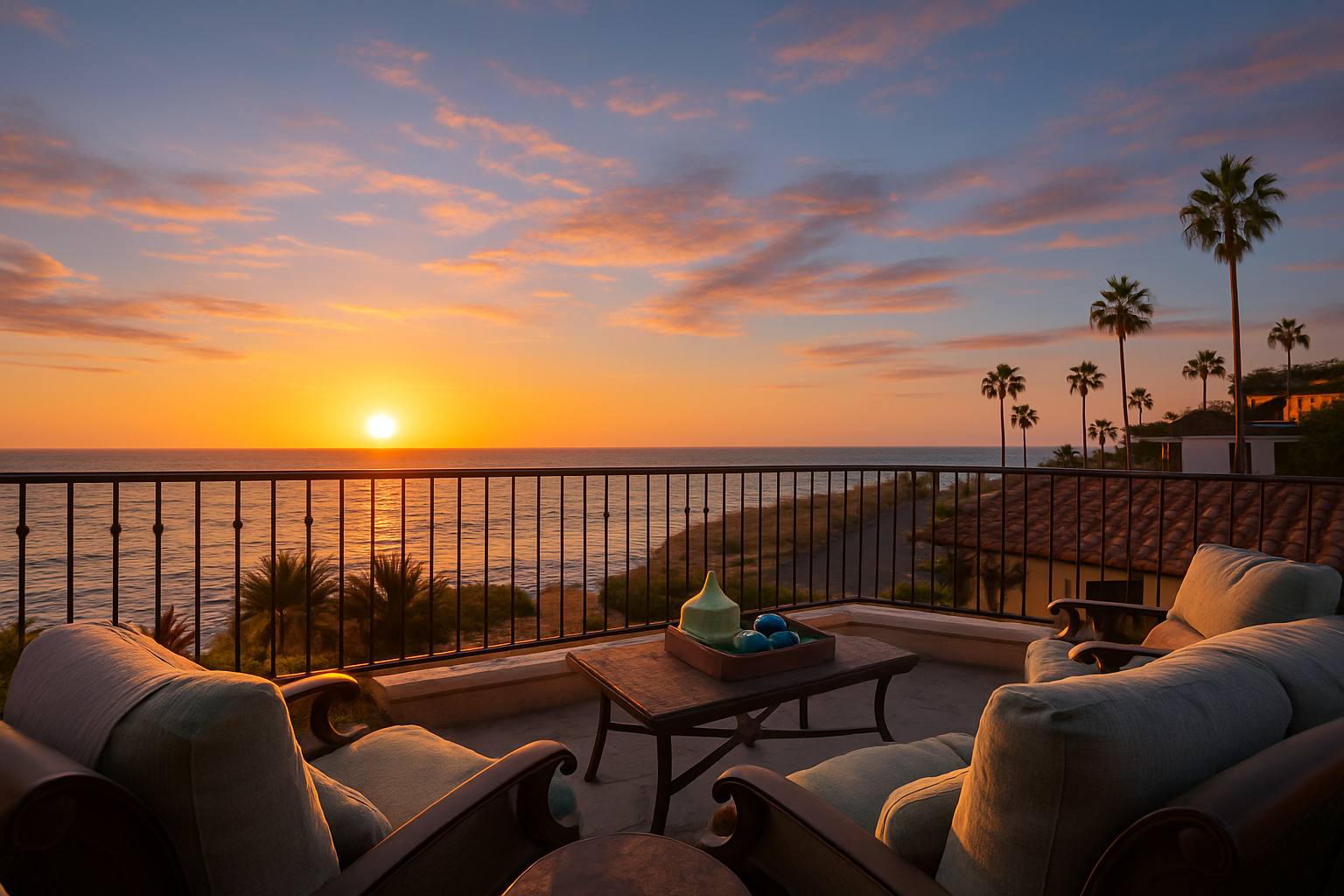
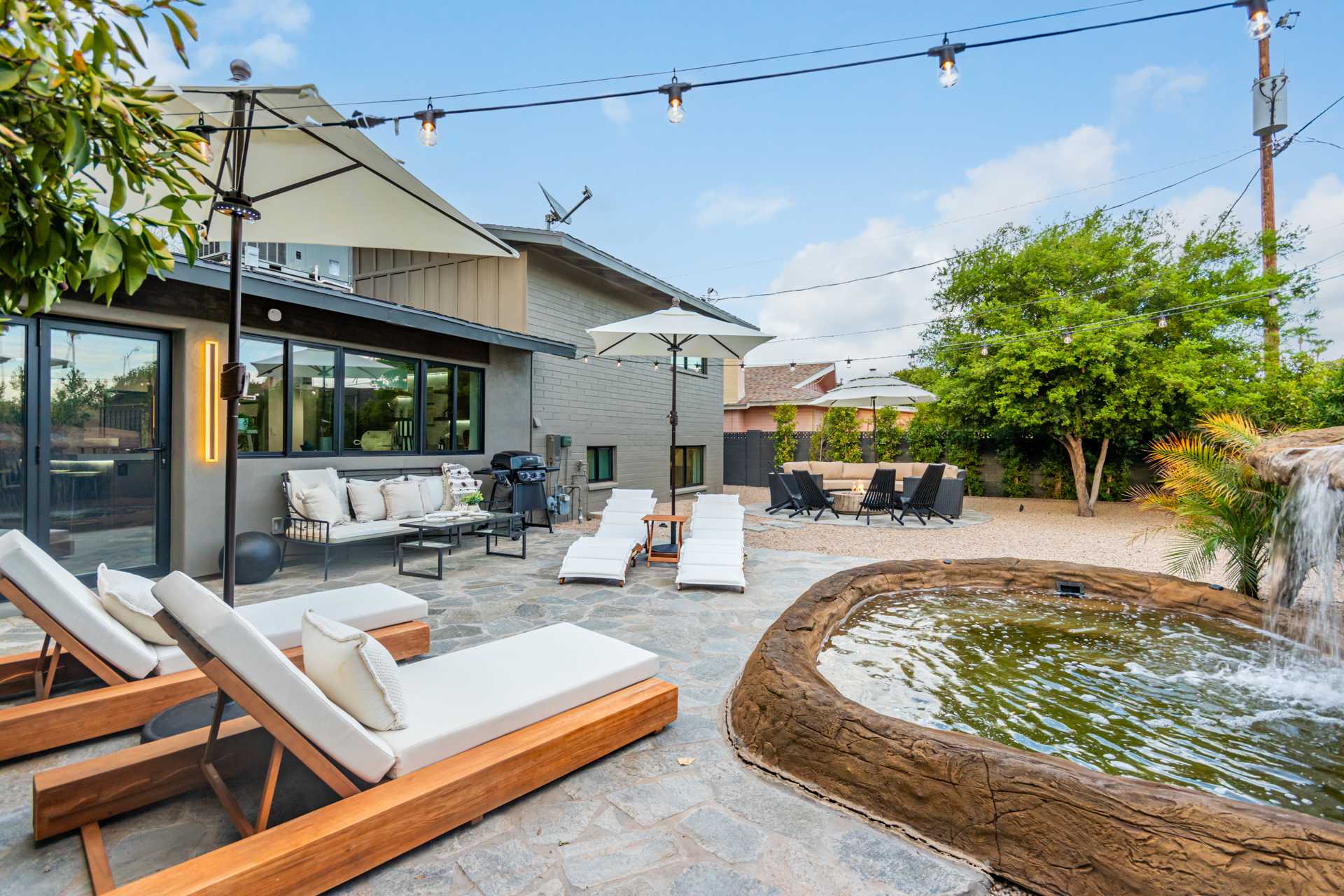

Nearby landmarks & attractions
Key destinations and attractions in the Palm Springs, CA area.
Palm Springs ↗ Maps
Mid-century modern architecture capital of the world — desert mountains, celebrity history, and the world's largest concentration of MCM residential design.
Joshua Tree National Park ↗ Maps
40 miles north of Palm Springs — desert boulder fields and the iconic Joshua trees at the Mojave-Colorado desert boundary.
Aerial Tramway ↗ Maps
Rides from desert floor to 8,500 feet in 10 minutes — pine forests and mountain trails above 110-degree valley heat.
This guide was assembled from the local knowledge of hosts with properties throughout Palm Springs, CA, as indexed by CielStay. The descriptions of restaurants, trails, swimming holes, and local tips reflect what hosts share with guests in their listings — not the observations of a travel journalist or guest reviewer. Photos are sourced from host listing images and are credited to their respective listings. Information about permits and trail conditions may change; always verify with official sources before your trip.