
The Concept
The Sea Ranch began as a design experiment. In 1963, Oceanic California (a Castle & Cooke division) bought the former sheep ranch on the Sonoma-Mendocino coast and hired landscape architect Lawrence Halprin to plan a residential community that would coexist with rather than dominate the landscape. The result — developed with architects Joseph Esherick, Charles Moore, Donlyn Lyndon, William Turnbull, and Richard Whitaker — was a set of design principles that became one of the most discussed architectural statements of the 20th century.
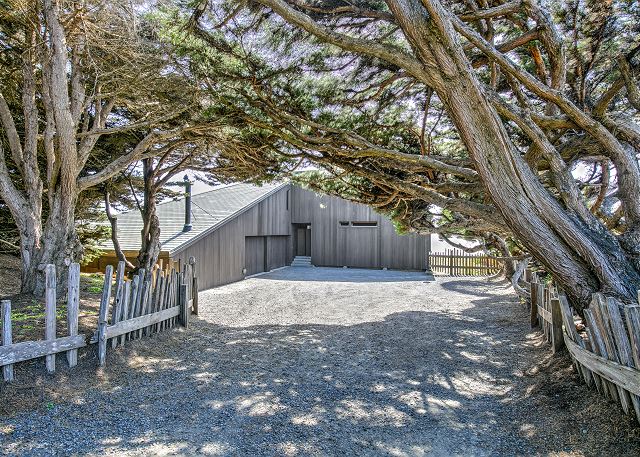
The guiding principles, loosely: buildings sit low in the landscape and use natural materials that weather. Hedgerows planted by sheep ranchers define the windbreak pattern and remain as lot boundaries. No fences between properties. Utility lines buried. Building footprints minimized so the meadows remain continuous. The resulting community of angular, cedar-sided structures hunkered low against the coastal wind has been studied and imitated worldwide; Condominium One is on the National Register of Historic Places, the project won the AIA Twenty-five Year Award in 1991, and SFMOMA devoted an exhibition to it in 2018–19.
Public access. The Sea Ranch is a private community, and only six Sonoma County Regional Parks access trails are open to the public, from north to south: the Bluff Top Trail, Walk On Beach, Shell Beach, Stengel Beach, Pebble Beach and Black Point. The Bluff Top Trail runs about 3 miles along the cliffs from Gualala Point to Walk On Beach. Park in the marked lots on Highway 1 and stay on the signed trails; other paths and roads in the community are private. As of October 2026 the county says Stengel Beach access is closed while the wooden stairway is replaced, expected through 2026; check the Sonoma County Regional Parks Sea Ranch access page before you go.
The coast itself: 40-foot cliffs, sea stacks, harbor seals on the rocks below, and gray whales passing offshore in winter and spring.
The Properties
Sea Ranch vacation rentals are handled by several local agencies (the Sea Ranch Association keeps a directory) and by independent owners. The inventory is almost entirely owner-occupied homes in the original architectural tradition — you are renting a 1960s or 1970s architectural landmark, not a resort room. Some are nationally published or designed by the original architects and their protégés.
The property types range from intimate one-bedroom meadow cabins to multi-suite oceanfront compounds. The common features: exposed wood structure, south-facing glass, fireplaces (standard, not optional), and a position in the landscape calibrated to maximize light while minimizing wind exposure.
Galleon's Point — designed in the original Sea Ranch tradition, on a private peninsula — represents the quality ceiling of the inventory. Horizon Reach by Barry Elbasani, FAIA, sits at the bluff edge near Black Point Beach with three separate suites and radiant heat. Hedgerow Haven is a premium oceanfront acre with its own bluff-top trail circulating the private grounds.
The Coast
The Sea Ranch is at the far north of the Sonoma coast, right on the Mendocino County line. The Sonoma Coast State Park beaches near Bodega Bay and Jenner are roughly an hour's drive south.
Walking: the county trails above are the way down to the water. Shell Beach, in the northern half of the community, has tide pools; Black Point Beach, at the south end, is the last of the six. Gualala Point Regional Park, at the Gualala River mouth just north of the community, has beach and river-mouth walks and whale watching in season.
Salt Point State Park, roughly 10 to 15 miles south, has tafoni sandstone formations, kelp forest and tide pools. Diving there is popular, though recreational red abalone take has been closed in California since 2018. Fort Ross State Historic Park, about 20 miles south past Salt Point, is the 1812 Russian settlement, among the southernmost Russian settlements in North America, with a reconstructed stockade and Orthodox chapel.
Food and supplies: inside the community, The Sea Ranch Lodge has a restaurant and bar, and a golf-links café operates at the course. Just south of the boundary, the Stewarts Point Store (1868) sells groceries, wine and sandwiches. The nearest towns are Gualala, just north across the river, and Anchor Bay, a few miles beyond, with restaurants, galleries and services. Mendocino, about 55 road miles (1.5 hours) north, has the full coastal town experience: galleries on Main Street, the Mendocino Coast Botanical Gardens, and the headlands state park.
Find your base in The Sea Ranch, CA — browse stays indexed by CielStay.
Search stays on CielStay →Frequently asked questions
What is the Sea Ranch architectural style?
The Sea Ranch's 1965 design vocabulary — by Joseph Esherick, Charles Moore, Donlyn Lyndon, William Turnbull, and Richard Whitaker, under landscape architect Lawrence Halprin — established principles that became internationally studied: unfinished wood that weathers to grey, low rooflines staying below the windward hedgerows, south-facing glass for passive solar, and structures positioned inside the landscape rather than on top of it. Condominium One is on the National Register of Historic Places, and SFMOMA staged an exhibition on the project in 2018–19.
Can the public walk the coast at The Sea Ranch?
Yes, on six county-run access trails: the Bluff Top Trail (about 3 miles from Gualala Point to Walk On Beach), Walk On Beach, Shell Beach, Stengel Beach, Pebble Beach and Black Point. Park in the marked lots on Highway 1 and stay on the signed trails, because the rest of the community's paths and roads are private. As of October 2026 Stengel Beach access is closed for stair replacement; check Sonoma County Regional Parks for current status.
How far is The Sea Ranch from San Francisco?
The Sea Ranch is about 110 to 120 miles north of San Francisco, roughly 3 hours. The usual route is US-101 north to Highway 116 or Highway 1 and then Highway 1 north along the coast. Skaggs Springs Road from Geyserville is an alternative, but it is winding mountain road and not faster. Summer and fall weekend traffic on Highway 1 can add time.
When is the best time to visit The Sea Ranch?
Late summer and early fall (August–October) usually have the most reliable dry weather, though coastal fog and wind are common year-round, so pack layers. Spring brings wildflower meadows in the open grasslands and gray whale migration into spring. Winter is dramatically atmospheric — large swells, sea stacks in the fog, empty trails — and the Sea Ranch community is quieter, with some of the architecturally significant properties available at lower rates.
Stays near this guide
70 homes within 6 mi on CielStay · all bookable on the host's own site. These are a few of them, chosen for this guide.
Browse every home in Sea Ranch.
Describe your stay and search
Or ask your AI assistant: Search the web for homes on cielstay.com in The Sea Ranch for 6 people
For exact dates and live prices, connect CielStay to ChatGPT, Claude or Gemini.


Try a search
Searches inspired by this guide — describe the vibe you want.
More guides


Nearby landmarks & attractions
Key destinations and attractions in the The Sea Ranch, CA area.
The Sea Ranch ↗ Maps
The landmark 1960s planned community by MLTW architects — weathered wood buildings that define California coastal design.
Salt Point State Park ↗ Maps
Sonoma coastline with tafoni sandstone formations, kelp forest and tide pools.
Gualala Point Regional Park ↗ Maps
Bluff-top park at the Gualala River mouth — excellent whale watching and beach access.
This guide was assembled from the local knowledge of hosts with properties throughout The Sea Ranch, CA, as indexed by CielStay. The descriptions of restaurants, trails, swimming holes, and local tips reflect what hosts share with guests in their listings — not the observations of a travel journalist or guest reviewer. Photos are sourced from host listing images and are credited to their respective listings. Information about permits and trail conditions may change; always verify with official sources before your trip.